
AI PO-to-SO Automation vs. Manual Order Entry vs. EDI: Which Wins?
A clear, side-by-side comparison of the three ways to turn purchase orders into SAP Sales Orders — manual entry, EDI, and AI PO-to-SO automation — with a simple framework for choosing the right one.

Short answer: Manual order entry is flexible but slow and error-prone; EDI is fast and reliable but only works with partners who can send structured EDI data; AI PO-to-SO automation reads unstructured purchase orders (email and PDF) and posts validated SAP Sales Orders automatically, making it the best fit for the messy, multi-format order streams most businesses actually receive. In practice, the strongest setup combines EDI for large structured partners with AI PO-to-SO automation for everyone else.
This guide breaks down all three so you can choose with confidence.
The three ways to turn a PO into a SAP Sales Order
Every business that receives customer purchase orders has to convert them into Sales Orders in SAP before fulfilment. There are exactly three methods to do it.
Manual order entry
A person reads each purchase order and types it into SAP — looking up customer and item codes, checking pricing and stock, and posting the Sales Order by hand. It is the default everywhere because it requires no setup and handles any format. It is also the slowest and least accurate method, and its cost grows linearly with order volume because the only way to do more is to hire more people.
Best for: very low order volumes, or one-off and highly non-standard orders.
EDI (Electronic Data Interchange)
EDI is a long-established standard for exchanging structured business documents between systems. A trading partner sends an EDI purchase order (for example an EDI 850) in a fixed, machine-readable format, and middleware maps it directly into a SAP Sales Order. EDI is fast, reliable, and accurate — for partners who support it.
The limitation is reach. Setting up EDI requires a technical mapping project per partner and a partner capable of sending compliant EDI. Large retailers and enterprise buyers have EDI; most small and mid-sized customers, distributors, and the long tail of buyers do not. EDI also handles only structured EDI data — it does nothing for a PO that arrives as a PDF or in an email body.
Best for: high-volume, ongoing relationships with large partners who already transact via EDI.
AI PO-to-SO automation
AI PO-to-SO automation reads the purchase order itself — whether it arrives as an email body, a PDF attachment, or a scanned document — using intelligent document processing, validates the extracted data against SAP master data in real time, and posts the Sales Order, routing only exceptions to a human. Unlike EDI, it needs no per-partner mapping and no special capability from the customer; the customer just sends a PO the way they always have. Unlike manual entry, it is fast, consistent, and scales without adding headcount.
Best for: any business receiving customer POs in varied formats — which is most businesses. See how it works in UpBuff’s Intelligent PO-to-SO automation.
Side-by-side comparison
| Dimension | Manual order entry | EDI | AI PO-to-SO automation |
|---|---|---|---|
| Handles unstructured POs (email, PDF, scans) | Yes | No | Yes |
| Setup effort | None | High (mapping per partner) | Low (no per-partner setup) |
| Works with any customer | Yes | Only EDI-capable partners | Yes |
| Speed per order | Slow (minutes) | Fast (seconds) | Fast (seconds) |
| Accuracy | Low (human error) | High (structured) | High (validated against SAP) |
| Scales without headcount | No | Yes | Yes |
| Real-time master-data validation | Manual | Limited | Yes |
| Human-in-the-loop control | Inherent | Minimal | Configurable |
| Keeps SAP as system of record | Yes | Yes | Yes |
How to choose: a simple framework
Use your order mix to decide, not a single method.
- Mostly a few large, EDI-capable partners? Lead with EDI for those partners. It is the gold standard for structured, high-volume, repeatable relationships.
- Mostly email and PDF POs from many customers? AI PO-to-SO automation is the only method that reads and validates them without manual transformation. This is the reality for manufacturers, distributors, and most mid-market businesses.
- Very low volume or genuinely one-off orders? Manual entry is fine — automating them would not pay back.
The key insight: EDI and AI PO-to-SO automation are complementary, not competing. EDI covers your structured channel; AI covers the long tail of unstructured POs that EDI can never reach. Together they get you close to fully touchless order processing, while manual entry shrinks to a handful of true exceptions.
What this looks like on SAP Business One and S/4HANA
Both EDI middleware and AI PO-to-SO automation post into SAP through official interfaces — the SAP Business One Service Layer and DI API, or SAP S/4HANA via OData and BAPI — so SAP stays the system of record and your upgrade path is protected. If you are starting from fully manual entry, the fastest, lowest-risk win is usually AI PO-to-SO automation on your busiest unstructured channel; our guide to automating sales order creation in SAP Business One walks through the steps.
Frequently asked questions
Is AI PO-to-SO automation a replacement for EDI? No. They solve different problems. EDI handles structured orders from EDI-capable partners; AI PO-to-SO automation handles unstructured POs (email, PDF, scans) from everyone else. Most businesses benefit from running both.
Is AI order automation accurate enough to trust? Yes, when it validates against live SAP master data and keeps a human in the loop. Clean orders post automatically; anything ambiguous — unknown items, price mismatches, credit issues — is routed to a person for review with the source PO shown alongside.
Which is cheapest? Manual entry has no software cost but the highest ongoing labour cost, which grows with volume. EDI has high setup cost per partner but low marginal cost at scale. AI PO-to-SO automation has low setup cost and scales without adding staff, making it the lowest total cost for varied, growing order volumes.
Do any of these modify the SAP core? No. All three keep SAP as the system of record. EDI and AI automation connect through official SAP APIs without changing ERP core logic.
The bottom line
If you are choosing one place to start, start where the pain is: the flood of email and PDF purchase orders that no one has time to key. That is exactly where AI PO-to-SO automation pays back fastest. See how UpBuff’s Intelligent PO-to-SO & Invoice Automation turns those orders into posted SAP Sales Orders — with validation, human-in-the-loop control, and a full audit trail — and book a demo to map it to your own order mix.
Related posts
View all posts »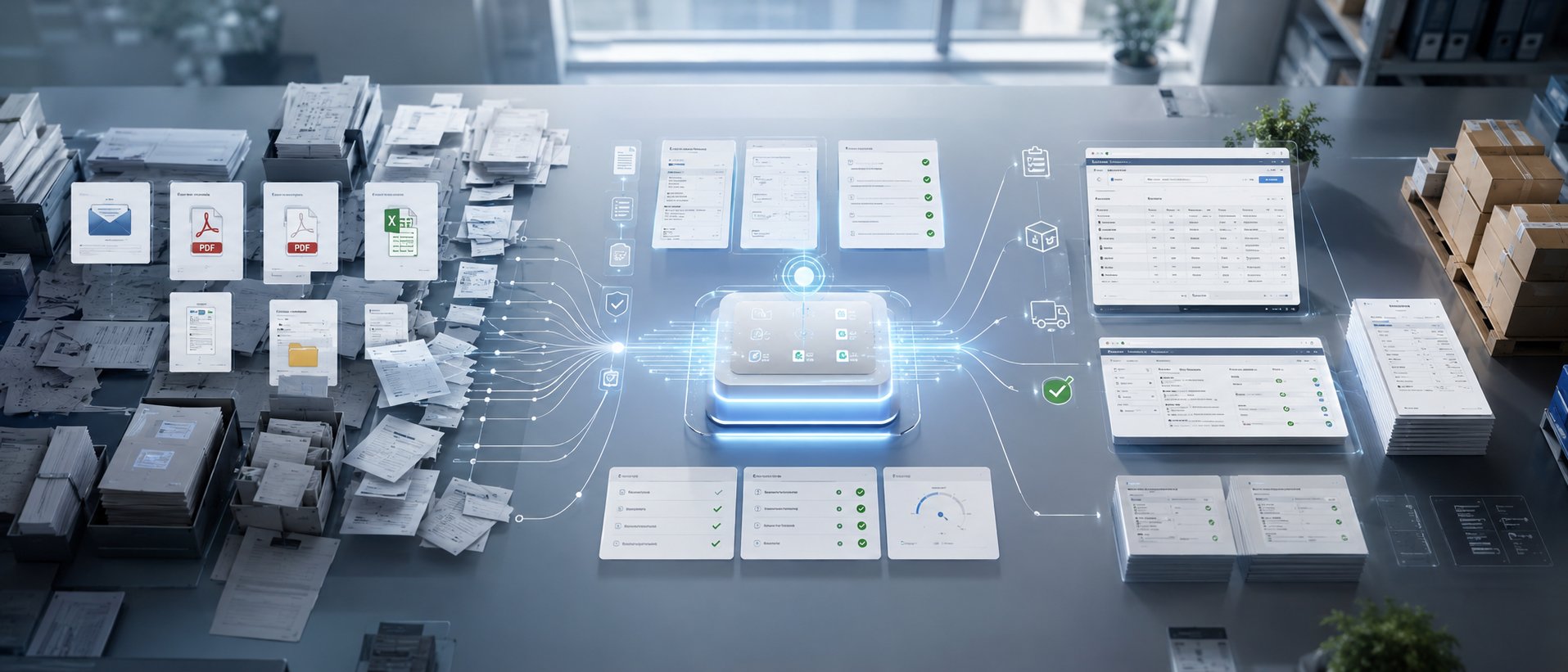 ERP Operations
 How to Automate Sales Order Creation in SAP Business One
Still keying customer POs into SAP B1 by hand? Here are the practical ways to automate sales order creation in SAP Business One — from native tools to AI-driven, touchless PO-to-SO automation.
 ERP Operations
 PO-to-SO Automation for SAP S/4HANA: The Enterprise Guide
How large enterprises automate purchase-order-to-sales-order conversion in SAP S/4HANA with AI — Clean Core compliant, human-in-the-loop, and without touching the ERP core.
 ERP Operations
 Touchless Order Processing for SAP Distributors: A Practical Guide
Distributors live or die on order speed and accuracy. Here's how touchless order processing turns the flood of email, PDF, and WhatsApp POs into posted SAP Sales Orders — without growing your order desk.