
PO-to-SO Automation for SAP S/4HANA: The Enterprise Guide
How large enterprises automate purchase-order-to-sales-order conversion in SAP S/4HANA with AI — Clean Core compliant, human-in-the-loop, and without touching the ERP core.

Short answer: PO-to-SO automation for SAP S/4HANA uses AI agents to read incoming customer purchase orders, validate them against S/4HANA master data and pricing in real time, and post Sales Orders automatically — connecting through official APIs (OData, BAPI, RFC) so the work stays Clean Core compliant and the ERP core is never modified. Exceptions route to a human, and SAP S/4HANA remains the system of record throughout.
For enterprises on S/4HANA, the question is rarely whether to automate order entry — it is how to do it without compromising governance, the Clean Core principle, or the upgrade path. This guide answers that.
What PO-to-SO automation means in an S/4HANA context
In SAP S/4HANA, a Sales Order is a core sales-and-distribution document. “PO-to-SO automation” is the process of converting a customer’s purchase order into that Sales Order without manual data entry: an AI agent extracts the order data from an email or PDF, checks it against S/4HANA master data, and creates the Sales Order through a supported interface.
The difference from a basic script or RPA bot is intelligence and control. The AI reads unstructured documents (no fixed templates), validates against live ERP data before posting, and keeps a human in the loop for anything ambiguous — so automation never posts a bad order silently.
Why S/4HANA enterprises automate order entry
The drivers are the same as anywhere, amplified by enterprise scale:
- Volume. Enterprises process large, continuous order volumes where even a small per-order handling time becomes significant cost.
- Accuracy and compliance. Regulated and audited environments cannot tolerate the pricing, tax, and item errors that manual keying produces.
- Talent. Skilled S/4HANA users should be resolving exceptions and exceptions only — not retyping POs that a machine can read.
- Speed to fulfilment. Faster order confirmation is a competitive and customer-experience advantage.
The non-negotiable: Clean Core and governance
The defining constraint for S/4HANA is Clean Core — SAP’s principle of keeping the digital core standard and unmodified so the system stays upgradable, cloud-ready, and maintainable. Any order automation must respect it.
Done correctly, AI PO-to-SO automation is inherently Clean Core compliant because it sits outside the core as an execution layer and integrates only through released, official interfaces:
- OData / Service Layer for modern, RESTful access to S/4HANA data and transactions.
- BAPIs and RFCs for standard, supported business operations such as Sales Order creation.
- No direct database writes and no core code modification — the ERP remains the authoritative system of record.
This is the same API-first, Clean Core-compliant approach behind UpBuff’s ERP integrations, applied to the S/4HANA digital core.
How AI PO-to-SO automation works on S/4HANA
The flow mirrors the steps in our SAP Business One automation guide, with enterprise-grade controls layered on top.
1. Capture
An AI extraction agent monitors order intake channels — email inboxes, customer portals, EDI for structured partners — and intercepts every incoming purchase order, structured or not.
2. Extract
Intelligent document processing reads the customer, items, quantities, and pricing from any PO layout, turning unstructured documents into structured order data without per-customer templates.
3. Validate against S/4HANA
The extracted data is cross-checked in real time against S/4HANA master data, condition-based pricing, tax determination, credit, and ATP/stock. Mismatches and exceptions are caught before posting.
4. Approve with human-in-the-loop control
Clean orders can post automatically; exceptions route to the right approver with the original PO shown side by side and full configurable thresholds — so governance and segregation-of-duties requirements are honoured.
5. Post and audit
Validated orders are posted as S/4HANA Sales Orders through OData/BAPI, the order is confirmed back to the customer, and every AI action, validation, approval, and posting is logged for a complete, encrypted audit trail.
How it fits with EDI and existing integrations
Most enterprises already run EDI for their large structured partners, and that should continue. AI PO-to-SO automation complements EDI by covering the unstructured long tail — the email and PDF POs EDI cannot read. For a full breakdown of when to use each, see AI PO-to-SO automation vs. manual order entry vs. EDI. Together they push the enterprise toward truly touchless order processing while keeping S/4HANA standard.
Frequently asked questions
Is AI PO-to-SO automation Clean Core compliant? Yes, when it integrates only through released interfaces (OData, BAPI, RFC) and makes no core modifications or direct database writes. It runs as an execution layer outside the digital core, so S/4HANA stays standard and upgradable.
Does it work with RISE with SAP and S/4HANA Cloud? Yes. Because integration is API-first through official, released interfaces, the same approach applies to S/4HANA on-premise, private cloud, and RISE with SAP deployments, keeping SAP as the system of record.
How is this different from RPA? RPA scripts replay fixed UI steps and break when documents or screens change. AI PO-to-SO automation understands unstructured documents, validates against live ERP data, and adapts to format variation — with human-in-the-loop review rather than blind execution.
Will it disrupt our SAP upgrade path? No. Keeping the core clean and integrating through supported APIs is precisely what protects the upgrade path. Nothing in the digital core is changed.
How quickly can an enterprise go live? Because there is no core modification, deployments typically start on a single order channel in weeks, run in manual-approval mode to prove accuracy, then expand automation thresholds from there.
The bottom line
For SAP S/4HANA enterprises, AI PO-to-SO automation delivers the speed and accuracy of automated order entry without compromising Clean Core, governance, or the upgrade path — because it extends the ERP rather than modifying it. See how UpBuff’s Intelligent PO-to-SO & Invoice Automation automates order and invoice processing across S/4HANA, and book a demo to scope it against your governance and volume requirements.
Related posts
View all posts »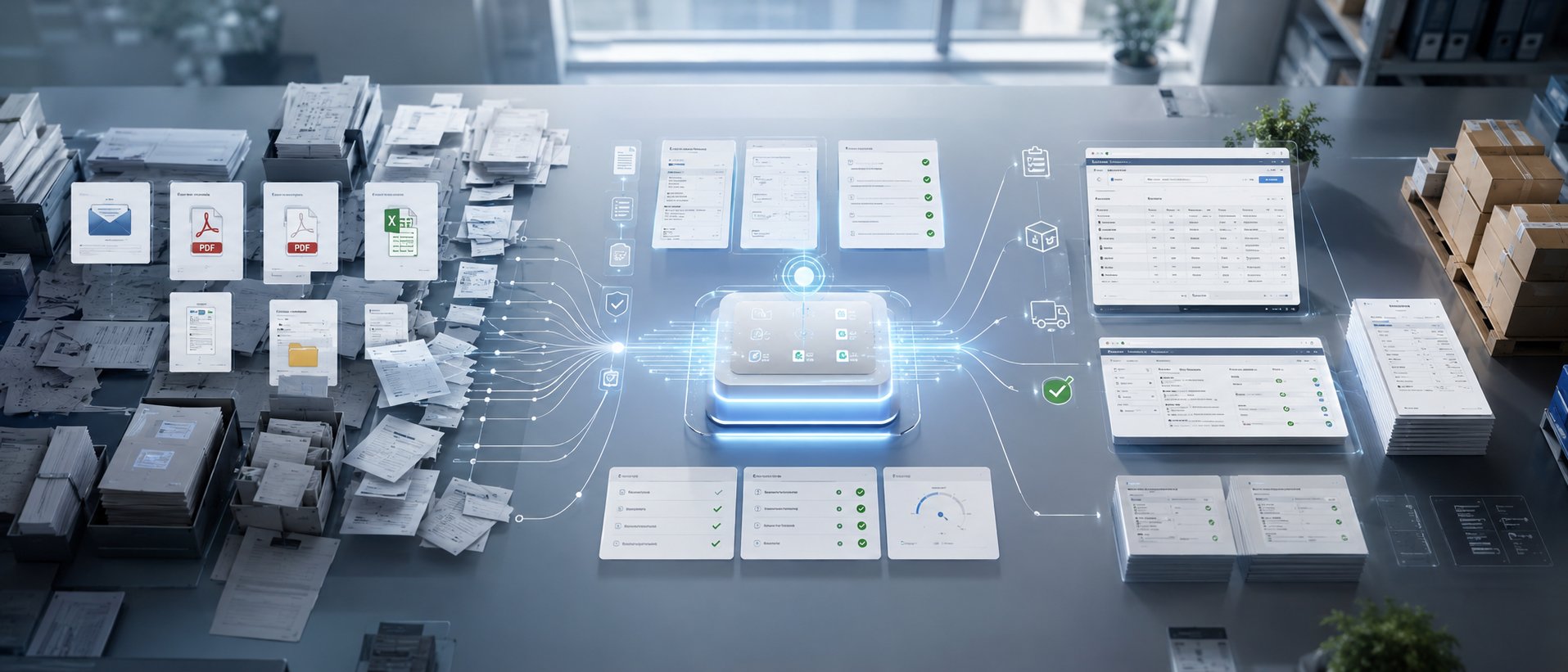 ERP Operations
 How to Automate Sales Order Creation in SAP Business One
Still keying customer POs into SAP B1 by hand? Here are the practical ways to automate sales order creation in SAP Business One — from native tools to AI-driven, touchless PO-to-SO automation.
 ERP Operations
 AI PO-to-SO Automation vs. Manual Order Entry vs. EDI: Which Wins?
A clear, side-by-side comparison of the three ways to turn purchase orders into SAP Sales Orders — manual entry, EDI, and AI PO-to-SO automation — with a simple framework for choosing the right one.
 ERP Operations
 Touchless Order Processing for SAP Distributors: A Practical Guide
Distributors live or die on order speed and accuracy. Here's how touchless order processing turns the flood of email, PDF, and WhatsApp POs into posted SAP Sales Orders — without growing your order desk.